How to Choose a UX Agency: A Framework for Founders and Product Managers
Business
Summary
Choose a UX agency by evaluating five evidence based criteria:
Relevant experience with your product type and audience, not just polished portfolios
A structured research process that includes user interviews and usability testing, not just visual design
Clear business impact metrics such as improved conversion, retention, or task success rates from past work
A collaborative process that includes your product and engineering teams with transparent communication
Transparent pricing and ownership terms before work begins.
Ask specific questions in every meeting: Who will actually work on the project? How do they validate assumptions before final design? What happens after designs are delivered?
How do you choose a UX design agency?
Evaluate against evidence, not impression. A polished website and a confident pitch tell you an agency is good at selling itself — they don't tell you whether the agency will make your product better. The five criteria that actually predict a good partnership are: relevant category experience, a real research process, proof of business impact, a collaborative way of working, and clear terms around pricing and ownership.
Score each shortlisted agency against these five before you weigh anything else — pricing, chemistry, timeline. Agencies that score well here tend to be the ones you're still working with two years later. Agencies that score well on "vibe" alone tend to be the ones you're replacing in six months.
What should you look for in a UX agency portfolio?
Look past the visuals for two things: relevance and outcomes.
Relevance means the agency has worked on something structurally similar to your product — same audience type (B2B vs. consumer), similar complexity (a five-screen app vs. a 40-system enterprise platform), or the same regulatory or cultural context if that matters to you (bilingual RTL/LTR markets, regulated industries like banking or healthcare). A gorgeous consumer app portfolio doesn't tell you much about whether an agency can handle an internal enterprise tool with six user roles and a compliance team.
Outcomes means the case study tells you what changed, not just what it looked like. "We redesigned the checkout flow" is a description. "We redesigned the checkout flow and cut cart abandonment by 22%" is evidence. If every case study in a portfolio is a before/after screenshot with no numbers attached, that's worth asking about directly — the agency either didn't measure impact, or the impact wasn't there to report.
What questions should you ask a UX agency before hiring?
Three questions do most of the work:
"Who will actually work on the project?" The person pitching you is rarely the person doing the work. Ask for the names and backgrounds of the actual team, and ask whether that team stays consistent for the project's duration or rotates.
"How do you validate assumptions before final design?" This is the research-process question in disguise. You're listening for user interviews, usability testing, or some structured way of checking a design decision against real user behavior — not "we have a lot of experience so we know what works."
"What happens after designs are delivered?" This surfaces the handoff process, whether they support implementation, and whether you own the files and source designs outright or need to keep paying them to access your own work.
A confident, specific answer to all three is a strong signal. A vague answer to any one of them is worth a follow-up before you sign anything.
How do UX agencies charge for their services?
Most fall into one of three models: fixed-scope project pricing, monthly retainers, or hourly/day-rate billing. Each has trade-offs.
Fixed-scope pricing gives you cost certainty but requires a well-defined project brief upfront — scope changes get expensive fast.
Retainers work well for ongoing product work where the scope evolves month to month, but only if the agency is transparent about what hours actually go where.
Hourly or day-rate billing offers flexibility but makes budgeting harder and rewards agencies for taking longer, not finishing faster.
Whichever model an agency uses, get the terms in writing before work starts: what's included, what counts as a change request, and what triggers additional cost. Agencies that resist putting pricing structure in writing, or that give you a number without a clear scope attached to it, are a red flag on their own.
What red flags should you watch for when hiring a UX agency?
Watch for these five in particular:
No research process, just design. If nobody on the team can describe how they validate a design decision before shipping it, you're paying for opinions, not evidence.
Case studies with no numbers. Portfolios full of pretty screens and zero measurable outcomes suggest impact was never tracked — or never happened.
Vague team composition. If they can't tell you who specifically will work on your project, assume it's whoever is available when the contract starts.
Unclear ownership terms. If it's not obvious that you'll own the final files, source designs, and IP after the engagement, ask directly and get it in writing.
No process for scope changes. Projects change. An agency with no defined process for handling scope creep will either blow your budget or blow your timeline — often both.
Any one of these is worth a direct conversation. Two or more, and the agency probably shouldn't be on your shortlist anymore.
Should you choose a specialist UX agency or a full-service agency?
It depends on what you need next, not just what you need right now. A specialist UX agency tends to go deeper on research, usability, and design systems — useful when the product experience itself is the main risk. A full-service agency (design plus branding, marketing, sometimes development) offers convenience if you need multiple disciplines working together, but UX can end up as one workstream among several rather than the primary focus.
If your core challenge is "users don't understand how to use this" or "we don't know why they're dropping off," a specialist is usually the sharper choice. If you're building a brand and a product simultaneously and want one team coordinating both, full-service can reduce coordination overhead — as long as UX doesn't get deprioritized against the more visible branding work.
How many UX agencies should you shortlist?
Three to five. Fewer than three and you don't have enough of a comparison to trust your own judgment — you're evaluating each agency against your assumptions instead of against each other. More than five and the evaluation process itself becomes a project, with diminishing returns on the extra time spent.
Run the same five criteria and the same three core questions against every agency on the shortlist, in the same format, so you're comparing like for like instead of relying on memory and impression after four different pitch meetings in the same week.
What is the most important question to ask a UX agency?
"How do you validate assumptions before final design?"
Every other factor — portfolio quality, pricing, team chemistry — matters less than whether an agency actually tests its decisions against real users before those decisions become expensive to change. An agency with a weaker portfolio but a rigorous research process will generally outperform an agency with beautiful case studies and no process for checking its own assumptions. This single question tends to separate agencies that design with evidence from agencies that design and hope.
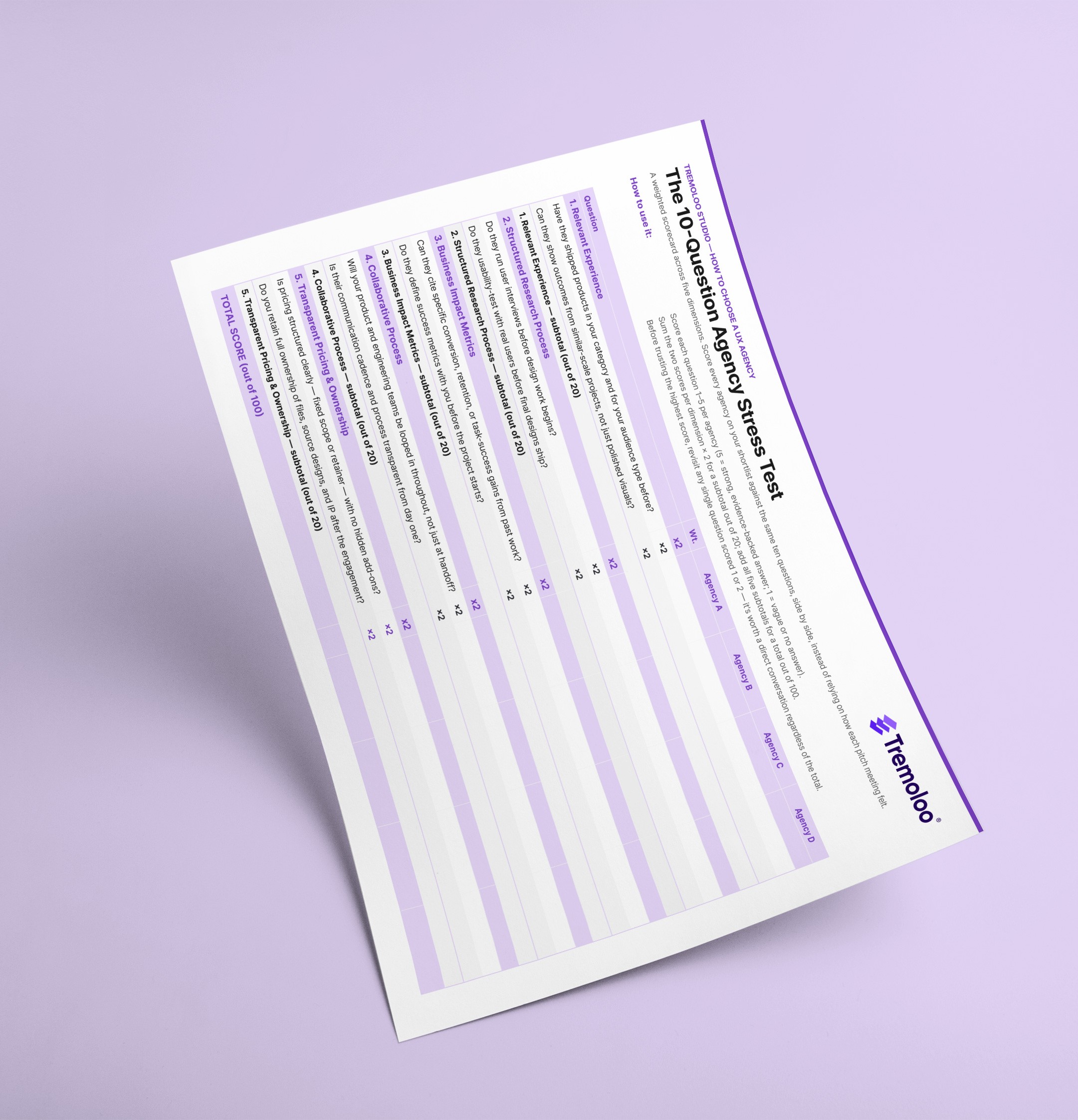
Free Guide
The 10-Question Agency Stress Test
We built the 10-Question Agency Stress Test as a weighted scorecard covering all five dimensions above, so you can put every agency on your shortlist through the same evaluation and compare the results side by side instead of relying on how each pitch meeting felt.